
 For a long time, I thought I had to apologise for my Silence. In the high-stakes world of international NGOs and the corporate offices of the Middle East, we are conditioned to believe that leadership is a performance. Rather than quiet leadership, we are told to be a “boss” we must be first to speak, the loudest to argue, and the most extroverted in the room.
A personal reflection on the ‘Noise of Leadership’, from Bdour Ghousheh
As an analytical introvert, I spent many years faking extroversion. I wore it like a heavy coat that left me exhausted by midday. I worried that my habits of listening, reflecting, and double checking of facts and data before speaking was a sign of weakness, after many years of self-reflection and self development journey I realised that I wasn’t the problem. The loud definition of leadership was.
The Quiet Leadership ROI is real
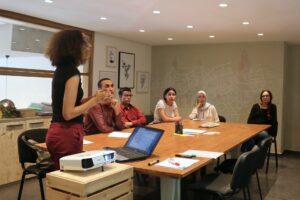 In the humanitarian and development sector, where decisions affect millions of lives, leadership cannot rely on speed alone. It requires reflection, listening, and analytical thinking — qualities often associated with quieter leadership styles.
We often overlook the “Analytical Leader”, Yet the numbers tell a different story, in our region, where complex problem-solving and risk mitigation are daily requirements, quiet leadership is a strategic asset.
Better Decisions: Research by Professor Adam Grant at Wharton shows that introverted leaders achieve higher profits than extroverts when managing proactive teams. This is because they listen to and implement the best ideas rather than dominating the conversation, this aligns with Susan Cain’s landmark book Quiet: The Power of Introverts in a World That Can’t Stop Talking (2012), which demonstrates how introverts bring creativity, deep thinking, and careful decision-making to leadership roles.
Economic Impact: Companies with “Cognitive Diversity” (a mix of introverts and extroverts) see a 19% increase in innovation revenue. When the loudest voice always wins, organisations fall into “Groupthink” and miss critical risks.
The Talent Gap: While women in the MENA region graduate from university at record rates (up to 70% in some nations), they hold less than 10% of senior leadership roles. Many of these women are “Quiet Leaders” whose analytical styles are misinterpreted as a lack of ambition.
From ‘Shy’ to ‘Strategic’
In our Arabic culture, we have a beautiful tradition of wisdom—the person who speaks last is often the most respected. Yet, in modern business, we have often traded “Prudence” for “Volume”.
Through my Quiet versatility leadership work, I am reclaiming this narrative. It is not about changing who we are; it is about Versatility. It involves:
- Scientific Decoding: Using behavioural data to understand the social styles of those around us.
- The Thinking Environment: Applying Nancy Kline’s principles to ensure that “quiet” insights are given the space to be heard.
- The Strategic Flex: Learning to communicate with high-assertive “Drivers” in a way that satisfies their need for speed while maintaining our need for accuracy.
The Path Forward
To my introvert women colleagues in the region who feel “too quiet” for the boardroom: Your silence is not a lack of confidence. It is a strategic pause. It is the sound of a deep-thinking leader assessing the best way forward.
In 2026, the Middle East doesn’t need more noise. We need more Quiet Power. We need leaders who can decode the room, analyse the risks, and lead with a steady, versatile hand. Please share your thoughts.
References
Boston Consulting Group (2018) How Diverse Leadership Teams Boost Innovation. Boston: BCG.
Grant, A.M., Gino, F. and Hofmann, D.A. (2011) ‘Reversing the extraverted leadership advantage: The role of employee proactivity’, Academy of Management Journal.
Kline, N. (1999) Time to Think: Listening to Ignite the Human Mind. London: Ward Lock.
Tulshyan, R. and Burey, J.-A. (2021) ‘Stop telling women they have imposter syndrome’, Harvard Business Review, 4 February.
World Bank (2022) Women, Business and the Law 2022: Middle East and North Africa. Washington, DC: World Bank.
Merrill, D.W. and Reid, R.H. (1981) Personal Styles and Effective Performance. Radnor, PA: Chilton Book Company
Cain, S. (2012) Quiet: The Power of Introverts in a World That Can’t Stop Talking. New York: Crown Publishing Group.


