
 In our overstimulated world, characterised, amongst other things, by hate speech on social media and by uncontrolled egomaniacs, the widespread inability to regulate one’s own emotions is becoming increasingly apparent. A stimulus is immediately followed by a reaction, without the ability (or willingness) to restrain oneself. Much suffering and harm occurs because no precautions are taken against triggers and emotions are not managed consciously. Yet emotional regulation can be learnt both individually and organisationally.
“Don’t react, respond” — that is the short formula for what emotion regulation is all about: not reacting to a trigger in the heat of the moment — whether it is minor or major — but taking the time to process the situation before responding to the stimulus. Sometimes, that might mean not reacting at all.
 A telling political example is the particularly emotive Israel-Palestine conflict. Last year, I had an ‘aha’ moment on this subject when the historian José Brunner, author of ‘Brutal Neighbours — How Emotions Can Fuel and Defuse the Middle East Conflict’ [1] — addressed emotions in a radio feature [2]. There are conflicts in which unchecked emotions fuel each other because each side sees itself as the victim and the other as the perpetrator. The existential fear felt by each side turns into anger and hatred.
Shifting your emotions
What is needed is a ‘shift in perspective’, as Brunner calls it. When asked why a peace treaty was nevertheless possible in the 1990s, he replied: The breakthrough only came when the heads of delegation agreed to stop looking back and look only forwards. Instead of continuing to argue over historical facts and their interpretation, they focused on what they had in common: both peoples want a life of security and peace.
Many successful peace treaties, according to the historian, were based on such an agreed ‘political forgetting’. Examples include the Peace of Westphalia in 1648, the foundation of modern Europe, or the peaceful end of the Franco dictatorship in 1975. The past was initially left to rest.
Managing your emotions so they don’t manage you
The same applies on a personal level: knowing your own triggers and, where possible, avoiding them as a precaution is a form of emotion regulation: looking to the future and seeking common ground, rather than arguing over who is right in their interpretation of what happened.
 There are many other ways to regulate emotions. Under the heading ‘Managing your emotions so they don’t manage you’, the US psychologist Ethan Kross has written the highly readable book “Shift” [3]. His basic thesis: Triggers cannot be eliminated — they are part of our life story — but we can deal with what follows them in a more conscious way: By anticipating a potential (strong) emotion, we can learn to influence it. Experiencing such self-efficacy is the key to regulation.
Emotions are sources of information. But just as they should not be expressed unchecked, they should not be suppressed either. The aim is to recognise them so that we can consciously influence them (see the box ‘What are emotions?’). Kross presents research findings on this and uses numerous examples to illustrate how emotion regulation and prevention work.
Kross encourages his readers to put together a personalised toolkit for regulating their emotions. This requires knowing one’s triggers and being keen to manage their consequences, as well as having the tools at the ready and rehearsed — because in a crisis, one is only able to use what one knows and is familiar using.
The fundamental form of regulation, he argues, is the human ability to direct one’s attention. This is like a mental spotlight that I can direct towards a situation — or remove from it. The easiest way to do the latter is through distraction. Distracting oneself may be appropriate, but it should not always be the method of choice.
Be aware of your senses
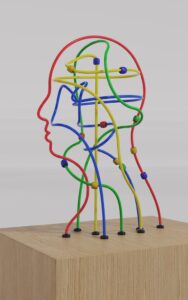 According to Kross, the most readily accessible means of shifting attention are the senses. Due to evolution, they are closely linked to emotions. For instance, birdsong and walks in the woods immediately lift the mood.
Or the sense of smell: churchgoers, for instance, are familiar with incense; the scents of lavender and juniper have a calming effect, which is why aromatherapy makes use of them — and massage makes use of touch.
Kross even suggests putting together a playlist for every mood, which helps to regulate one’s state of mind via the sense of hearing.
Other ways to regulate emotions include
- Changing your perspective: stepping back and adopting the position of a proverbial fly on the wall, observing the upsetting events from a distance. When engaging in inner monologues, switch from the first person to the second or third person – this ‘distant self-talk’ creates inner distance: instead of, for example, initiating an emotional reaction by saying ‘that really annoys me right now’, say: ‘Kuno is quite taken aback right now. What could he do, apart from getting annoyed?’
- Gaining temporal distance: First go for a walk when something upsets you, then look for the answer. Don’t send an emotional email straight away; sleep on it instead. Then decide whether and how to respond.
- External regulation: Limit sources of stimulation, such as switching off your mobile phone, leaving the scene of the incident, and consciously seeking out places that act as personal ‘happy places’ to help you calm down. Kross also encourages keeping a short list of those people with whom you feel truly heard, whether in a professional or private context. Helping others and maintaining shared rituals has also been shown to boost well-being and a sense of connection.
- Put it into practice using the WOOP method: Wish, Outcome, Obstacle, Plan – this tried-and-tested method links your desire with your inner barriers to form an action plan. You formulate a specific wish — ‘not to feel blocked when speaking in front of others’ — and visualise the fulfilment of that wish — ‘my concerns will be heard’. Then you identify the inner obstacles — ‘if I feel caught off guard, I can’t get a sentence out’ — and draw up an if-then plan: ‘If I know that I want or need to say something today, I’ll write down the first two sentences, which I can read out to take the pressure off’.
What does this mean for organisations?
An organisation’s culture is shaped largely by its employees’ emotions – and thus also by the regulation of emotions at an individual level. But this also applies at a collective level within the group – which constitutes an important part of the culture. And the better the culture, the more comfortable employees feel and the more successful the work is. Conversely, organisational culture influences their emotions and helps regulate them. On the one hand, in the sense of the ‘external regulation’ mentioned above — for example, through comfortable office spaces and areas for interaction. This starts with the coffee machine and doesn’t stop at the choice of wallpaper.
On the other hand: the foundation for a good and successful organisational culture is laid when culture, just like finances and projects, is regularly discussed. A corporate culture encompasses values and beliefs, norms and rules, as well as practices and behaviours. Expressed in the image of a water lily: invisible roots represent values, the stem represents norms, and the flower represents behaviour.

Not just buzzwords
An unhealthy culture often arises when values are merely assumed but not clearly defined together, or when standards are reduced to mere buzzwords. Operational disruptions usually stem from differing interpretations of values or standards that are applied inconsistently – for example, when ‘commitment’ is quantified solely in terms of constant overwork (rather than qualified by diligence): Busyness is doubly unhealthy, for oneself and for the organisation.
Culture can primarily be changed through behaviour. Well-worded guiding principles are not enough. Rules such as ‘We look out for one another’ require appropriate practices to be put into effect: time for dialogue, buddy systems, psychosocial support, joint activities. Such practices, rituals and spaces for interaction also make cultural change tangible.
And how do we move from insight to action?
By actively nurturing existing good practices and gradually incorporating new desired patterns into our routines, for example through WOOP group plans.
What are emotions? What is emotion regulation?
According to Ethan Kross, emotions are the feelings, thoughts and physical reactions that arise during significant (or anticipated) events. They consist of physiological reactions (e.g. an increased heart rate), cognitive assessment (e.g. ‘Watch out, danger!’), and expression (facial expressions, voice).
Emotions are important and should not be suppressed; they help us navigate situations. They are therefore not, as is often misunderstood, the opposite of rationality. Rather, emotion and cognition are closely linked; they influence and regulate one another. However, they can, may, and should be consciously regulated when they are too intense and make an overreaction likely, for example, in the form of an outburst of anger.
Emotional regulation is the ability to control the emotional response to a trigger by slowing it down or speeding it up, or by adjusting its intensity, by accepting the emotion as a signal and a source of information rather than as noise or a disturbance to be suppressed. We cannot control the triggers; the emotion is an automatic reaction. However, we can take precautions and dampen (or fuel) the emotional fire, thereby influencing what follows.
The intensity of negative emotions does not diminish, however, when one engages with them, as the psychologist and therapist Gitta Jacobs writes in her book ‘Too Much Feeling’ (in German only). These could even worsen when attempting to process them.
NB: Fear is the most frequently ‘abused’ emotion – particularly by those in power when they threaten the powerless.
What do you think?
Share a reply about your experiences below.
Literature
[1] José Brunner in ‘Echo der Zeit’, 20.7.2025.
[2] José Brunner, Brutale Nachbarn – Wie Emotionen den Nahostkonflikt antreiben – und entschärfen können, Propyläen Verlag, 2025.
[2] Ethan Kross, SHIFT – Managing your emotions so they don’t manage you, New York, CROWN, 2025 – It makes for a very good read, provided you don’t let the optimism and the occasionally contrived heroic tales put you off too much.
Based on an original German article published by B’VM.


